
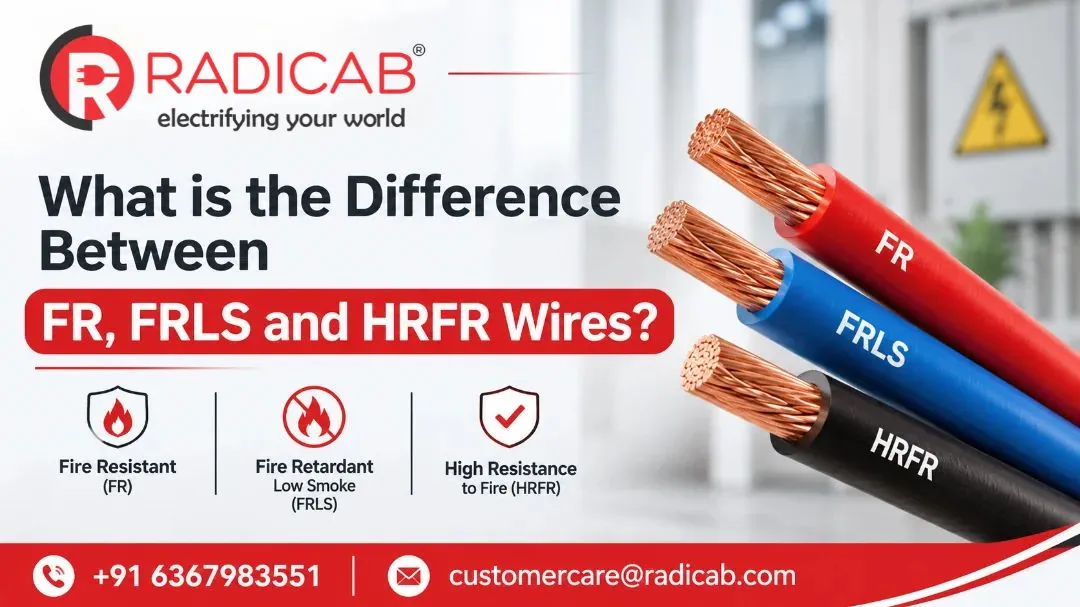
Fire resistance is a major point in electrical safety today. Simply providing electrical insulation is not enough for modern wires. During fire accidents, it has been observed that the wires can speed up the spread of flames due to their quick flammability. Therefore, the electrical cable manufacturers now provide wires with fire-resistant qualities. When you buy fire-rated wires and cables, you may come across the terms FR, FRLS, and HRFR. All these have similar properties but have major differences, especially when it comes to applications. To avoid confusion while buying, you can refer to this guide.
Definition
FR Wires
The term “FR” indicates that these wires feature flame-retardant properties. The insulation used in these wires is specifically formulated and made from PVC that resists catching fire and stops flame spread on the wire. The FR wires are designed such that once an external fire source is removed, the insulation material can self-extinguish under certain applied test conditions.
FRLS Wires
The abbreviation “FRLS” means Flame Retardant, Low Smoke. FRLS wires are created to provide flame-retardant properties and produce significantly less amount of smoke compared to other wires.
HRFR Wires
HRFR stands for heat-resistant flame-retardant. Wires made of specialized insulation can resist much higher temperatures while also being flame-retardant. These can operate at temperatures as high as 85 degrees Celsius.
Key Features
FR Wires
- Protects from the spread of flame through the cable.
- The most commonly used insulating material is flame-retardant PVC.
- An affordable solution for electrical safety.
FRLS Wires
- Generates less smoke in case of fire.
- During combustion, toxic fumes are very limited.
- Less smoke means better visibility for evacuation.
HRFR Wires
- Functions at higher temperatures.
- Prevents the spread of fire.
- Insulation still works at high temperatures.
Applications
FR Wires
FR wires are mainly used in general electrical installations that require flame-resistant insulation.
– Homes and flats
– Lighting and power circuits
– Small businesses
– Electric distribution systems
– Regular indoor wiring projects
FRLS Wires
FRLS wires are normally used in closed and occupied areas where it is necessary to limit smoke production. Here are some examples of where the wires can be applied:
– Tall residential buildings
– Malls and shopping centers
– Offices and business center
– Medical institutions
– Schools and universities
– Hotels and public spaces
HRFR Wires
HRFR wires are used where higher resistance to operating temperatures is needed. Some examples include:
– Residential wiring
– Commercial buildings
– AC wiring
– Kitchen appliance wiring
– Geyser connections
Conclusion:
The choice of fire-rated wires can be made easily by understanding these differences. FR wires are generally used for standard home wiring. FRLS is applicable where space is limited, and you need visibility. HRFR wires are suitable for elevated temperatures and dense electrical connections.
At Radicab, we offer a broad range of wires and cables with appropriate flame retardant properties. Explore our catalogue and find your suitable cables.
Frequently Asked Questions
Both types of wires are flame-resistant. It is common for buildings like hospitals, high-rise buildings, office complexes, malls, and so on to use FRLS cables. At the same time, FR cables are used in installation work.
No, FRLS cables are not fireproof. FRLS cables are used for flame-resistant purposes only and tend to emit less smoke when compared to other types of cables.
HRFR cables are suitable for residential installation, provided that all the cable parameters such as conductor size, carrying capacity, and so on are met.
FRLS cables are normally favoured for use in tall buildings because of their low amount of smoke and flame-resistance properties. However, depending on the type of project and its fire safety situation, other fire-resistant cables may also need to be used.