
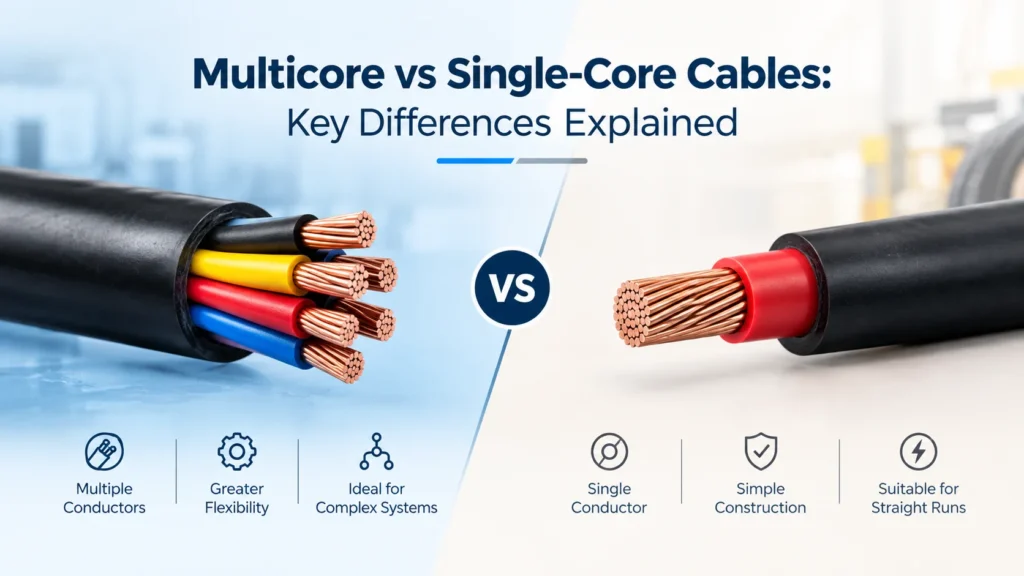
A multicore cable is different from a single-core cable as it contains various insulated conductors in one sheath. The difference between multicore and single-core cables should be known when planning the installation process and when understanding cable aspects, heat dissipation, and maintenance plans. According to LP Information market research, the global multicore cables industry was worth USD 79.83 billion in 2025 and is expected to grow to USD 133.79 billion by 2032. The CAGR from 2026 to 2032 is projected to grow at 6.6 %, reflecting the usage of multicore cables in many sectors, such as industrial equipment, control systems, power applications, automation, and infrastructure projects.
What Is a Multicore Cable?
A multicore cable is defined as a cable containing two or more insulated conductors surrounded by an outer sheath. The conductors in a multicore cable are capable of carrying an electrical charge, while the sheath protects the cable against damage and moisture. Multicore cables carry several conductors together, so the magnetic fields produced by the conductors can partially balance or cancel each other when the currents are arranged appropriately. This can reduce the external magnetic field and associated electromagnetic interference (EMI).
Factors To Consider When Choosing Wire and Cable Suppliers
The variety of cables available for different uses is huge. Here are the key factors to consider when selecting companies supplying wires and cables:
Construction of a Multicore Cable
Each conductor is made from either copper or aluminum and insulated separately from all the others, so all the cores can be assembled into one multicore cable. They are commonly available in 2, 3, 4, or 5 cores.
Common Applications
The scope of application of a multicore cable includes control panels, industrial machinery, building wiring, instrumentation, and various applications where several circuits or connections have to be laid together.
What Is a Single-Core Cable?
A single-core cable has one conductor and may also be covered with insulation and protective materials as needed. Since each cable can accommodate one electrical circuit only, various cables are required when installing several conductors.
Construction of Single-Core Cables
The conductor is made of either copper or aluminum depending on the required properties of the conductor both electrically and mechanically. The conductor is enveloped in insulation that prevents current from leaking to other conductors or to people. They generally use non-magnetic armour, such as aluminium, as specified for applicable cable constructions under IEC 60502-1.
IEC 60228 defines the general requirements for both cable types. IEC 60502- 1 is for low-voltage cables, while IEC 60502-2 is for medium-voltage cables.
Key Differences
Number of Conductors
A multicore cable comprises multiple conductors that have been insulated and housed in a single outer sheath. A single-core cable can only have one conductor. This allows multicore cables to be used in situations where numerous electrical lines need to be run together.
Installation and Space Requirements
Instead of managing a number of cables, a multicore cable provides the advantage of running multiple conductors through one cable.
A single-core cable provides more freedom in the routing of conductors.
Cable Management
Multicore cables allow many connections to be arranged through one cable. This is ideal in cable trays, conduits, panels, and equipment.
When using single-core cables, it is necessary to install each conductor individually. With an increasing number of conductors, proper cable management becomes necessary.
Heat Dissipation
In multicore cables, several conductors are bundled together in a single sheath. Thus, heat generation due to the flow of current must be taken into account in conjunction with the type of construction of the cable and the installation conditions.
For single-core cables, the distance between cables can also influence heat dissipation. When determining the cable rating, engineers should consider the size of the conductors, ambient temperature, method of grouping and installation, and allowable temperature.
Comparison Overview
Feature | Multicore Cable | Single-Core Cable |
Number of Conductors | Contains two or more insulated conductors within one outer sheath. | Contains one insulated conductor. |
Construction | Multiple cores are grouped and protected by a common outer sheath. | One insulated conductor, often with its own sheath or armour |
Installation | Suitable when multiple connections need to be routed together. | Suitable when individual conductors need separate routing. |
Space Requirement | Can reduce the number of separate cable runs in an installation. | Multiple cables may require more routing space. |
Heat Dissipation | Closely positioned cores can affect heat dissipation and current-carrying capacity. | Spacing between individual cables can influence heat dissipation. |
Typical Applications | Commonly used for control panels, machinery, instrumentation, and industrial systems. | Commonly used for power distribution, switchboards, and high-current installations. |
Conclusion
The right decision depends upon many variables including current capacity, voltage, number of conductors, space available, heat dissipation, installation location, and maintenance requirements. Electrical contractors and engineers can evaluate these aspects and select multicore cable manufacturers that meet the relevant specifications to create safer and more structured electrical systems.
Get in touch with Radicab and find suitable cables for your project.
Frequently Asked Questions
A multicore cable is an assembly of multiple conductors within the same outer sheath, while the multi-strand cable has several fine strands twisted together in the same insulation cover.
A multicore cable should be used instead of single-core when the installation needs several connections between the same points.
By carrying multiple circuits in a single cable, multicore cables simplify installation and reduce cable clutter.
The number of separate electrical circuits required by the application determines the number of cores in the cable.
Not necessarily. Flexibility depends on the construction, cross-sectional area, insulation, and not just the number of cores.